Best Age for Ultherapy or Thermage in Busan | Newline Clinic
Ultherapy & Thermage · Age and timing guide

Best age for Ultherapy or Thermage
in Busan
Newline Clinic Seomyeon.

There is no single “correct age” to start Ultherapy Prime or Thermage FLX. A more useful decision starts with what has actually changed: jawline definition, lower-face laxity, skin firmness, facial contour, previous treatments and how much improvement you realistically want. This Newline guide replaces rigid age brackets with a concern-first framework.

Age is not the only factor Ultherapy Prime confirmed Thermage FLX confirmed Individual treatment planning
What matters more than age

Six factors that guide lifting treatment.

Visible laxity
Assess
Jawline
Assess
Skin firmness
Assess
Previous treatment
Review
Treatment area
Confirm
Budget / recovery
Plan
If you only read one paragraph

The best time to start is when the treatment matches a real concern — not when you reach a specific birthday.

Newline currently confirms Ultherapy Prime, Thermage FLX, XERF, Shurink Universe and ONDA. The choice between them should depend on what you want to improve, the treatment area, anatomy, device mechanism, shot count or energy level, previous procedures and expected recovery. Some people may consider lifting earlier; others may not need it until later. Chronological age is context, not the prescription.

Six life-stage questions

How age can inform — not dictate treatment.

01

20s: is there a real lifting concern?

Instead of assuming someone is “too young,” start by asking whether there is visible laxity or another concern that fits an energy-based lifting treatment. If not, a different category may be more relevant.

Question Is lifting actually the problem?
02

30s: look at anatomy, not the number

Some people notice early jawline softening or firmness changes in their 30s; others do not. Previous weight changes, sun exposure, genetics and facial structure may matter more than the age itself.

30s Case-by-case
03

40s: concerns may become clearer

Patients may begin noticing more obvious changes in firmness or contour, making an ultrasound or RF lifting discussion more relevant. Device choice still depends on the actual treatment target.

40s Concern-led planning
04

50s: compare mechanisms carefully

More visible laxity may lead to discussions about ultrasound, RF, thread lifting or combinations. More treatment is not automatically better; each modality should have a specific role.

50s Mechanism matters
05

60s+: set the right treatment goal

Non-surgical lifting may still be considered, but expectations should match the degree of laxity and anatomy. Some concerns may require a different approach than energy devices alone.

60s+ Expectation matters
06

Any age: reassess after change

Weight loss, facial-volume change, prior procedures or a new concern can change the treatment plan. Do not keep repeating a device simply because it was used previously.

Any age Reassess before repeat
Beyond chronological age

Six factors that may change the timing.

☀️

Sun exposure history

Long-term sun exposure can affect skin quality, but it does not automatically mean HIFU or RF is the correct treatment. Identify whether the concern is laxity, pigmentation, texture or another category.

🧬

Family facial-aging pattern

Genetics can influence when jawline or lower-face changes become noticeable. Family history is useful context, not a stand-alone indication.

⚖️

Weight change

Weight loss or gain can change facial contour and perceived laxity. Reassess anatomy before choosing a device or repeating previous treatment.

🧴

Skin-quality concern

If the main issue is texture, pores, pigmentation or hydration rather than laxity, Newline may discuss a different confirmed treatment category instead of lifting.

📆

Events and travel

Weddings, photos, business meetings and flights should be considered when choosing timing. Result development and visible recovery vary by device and individual.

📝

Previous treatment history

Tell Newline which devices, shot counts and treatment dates you have had. Previous treatment can influence how the next plan is built.

Confirmed Newline lifting options

Choose by mechanism and concern.

Ultherapy Prime

Confirmed ultrasound lifting option. Newline currently lists 100, 300, 400 and 600-shot price points. Ask which area is being treated and why that shot count is appropriate.

Thermage FLX

Confirmed RF lifting option with 100, 300, 600 and 900-shot pricing plus Eye 225 and Eye 450 options. Age alone does not determine whether RF is preferable.

XERF

Confirmed RF lifting option with 100, 300 and 600-shot price points. It should be compared by treatment goal, area and settings rather than by age label.

Shurink Universe

Confirmed ultrasound lifting option with Ultra F and Ultra Booster pricing. Lower price does not automatically mean it is the correct option for every patient.

ONDA

Confirmed face and body energy-based option with kJ-based pricing. It should be evaluated as its own category rather than as a direct substitute for Ultherapy or Thermage.

Thread lifting

Mint Thread Lift and EnCog / Scaffold Thread Lift are confirmed Newline categories. Thread procedures involve a different recovery and decision framework from device-based lifting.

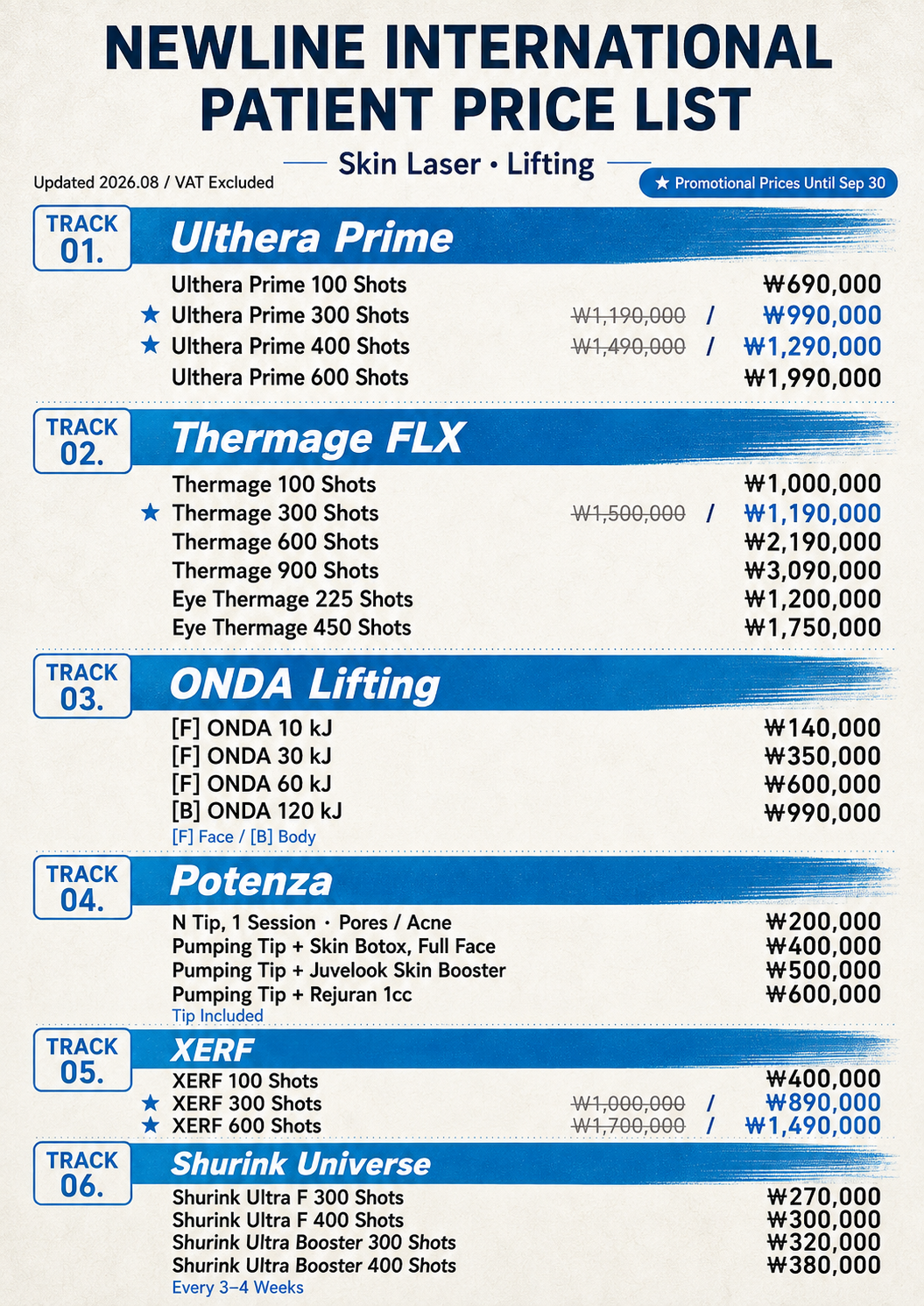
Current price reference

Ultherapy Prime & Thermage FLX at Newline.

Ultherapy 100
₩690,000
Ultherapy 300 Promo
₩990,000
Ultherapy 400 Promo
₩1,290,000
Thermage 100
₩1,000,000
Thermage 300 Promo
₩1,190,000
Thermage 600
₩2,190,000
Decision framework

Start with the concern, not the decade.

A lifting consultation may make sense if

  • You notice jawline or lower-face laxity
  • Skin firmness has changed noticeably
  • You want to compare ultrasound and RF mechanisms
  • You have a clear treatment area in mind
  • You are ready to discuss realistic improvement rather than transformation

Reconsider the treatment category if

  • Your main concern is pigmentation
  • Pores or acne-related texture are the priority
  • Hydration or skin quality is the main goal
  • You are choosing treatment only because of age
  • You are following someone else's treatment schedule

Do not rely on these assumptions

  • Everyone should start in their late 30s
  • 40s–50s are automatically the “best age”
  • Annual treatment is required
  • Older age always needs multiple devices
  • More shots or more devices always produce better results
Repeat treatment planning

Maintenance should be response-based.

No automatic annual rule

This page does not prescribe one Ultherapy or Thermage session every year for every patient. Repeat timing should depend on response and changing concerns.

No automatic twice-yearly rule

Age alone does not justify alternating HIFU and RF every six months. If multiple devices are suggested, ask what each one is intended to add.

Reassess before repeating

Compare current anatomy with previous photos and treatment records rather than simply repeating the last shot count or package.

Confirm current price

Promotions and pricing can change. Confirm the device, shot count, area and final VAT-inclusive amount before each treatment.

Legacy page cleanup

What was removed or corrected.

No fixed “best age” claim

The old page labeled late 30s as preventive, 40s–50s as ideal and 45–55 as the strongest-results window. Those universal age rules were removed.

No age-based maintenance schedule

Annual, twice-yearly and quarterly treatment rules based solely on decade were removed.

No Volnewmer service claim

Volnewmer is not in the confirmed current Newline service/price information used for this page.

No Exosome recommendation

Exosome therapy is not included in the confirmed current Newline service information used here.

No 24-hour personalized recommendation guarantee

Newline does not promise a physician recommendation within a fixed messaging-response window.

Physician and NAP information corrected

Legacy physician claims, old contact details and old address data were replaced with current Newline information.

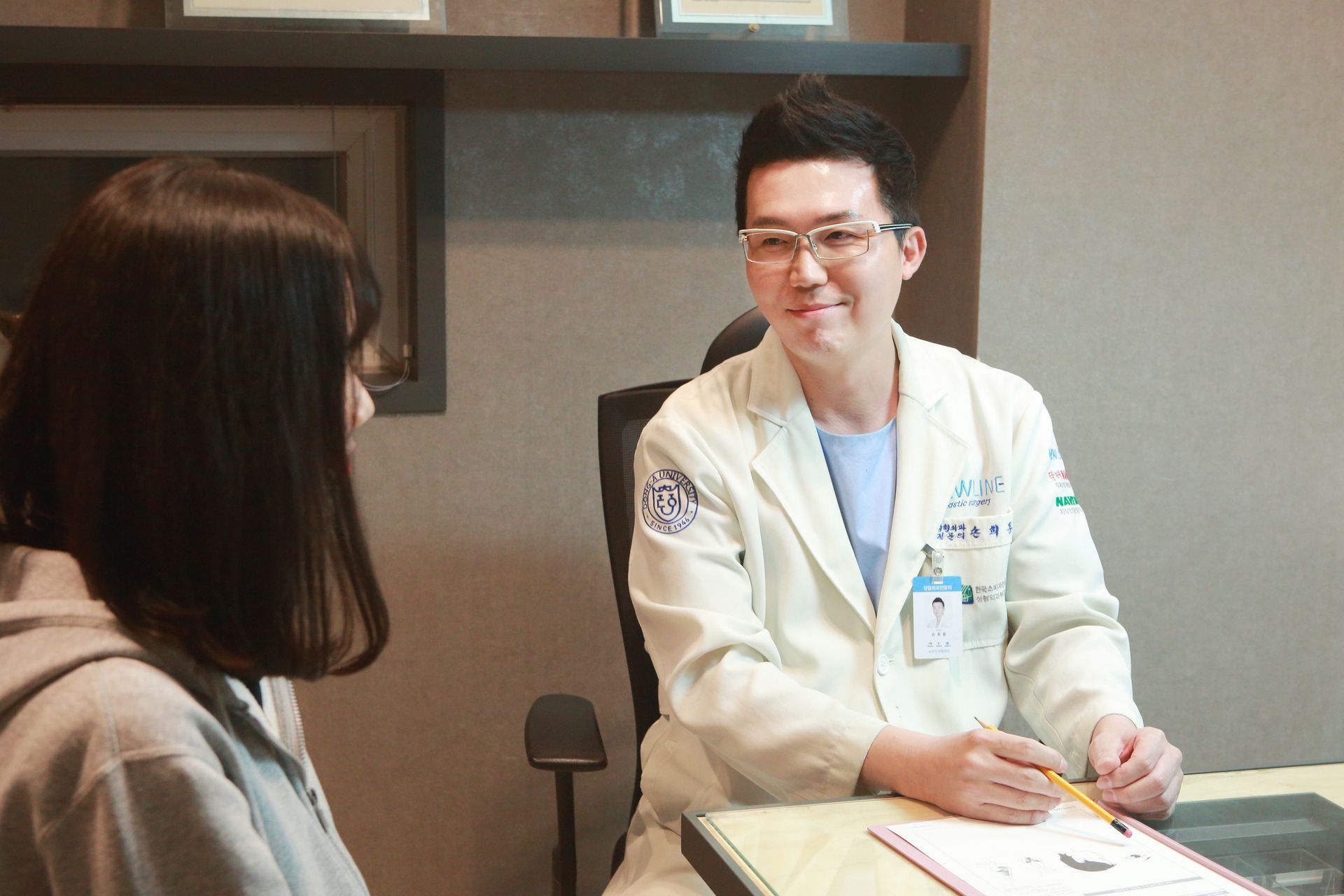
Son Hee-dong, MD, PhD, Chief Director at Newline Clinic Busan
Chief Director

Son Hee-dong, MD, PhD
board-certified plastic surgeon.

The right time for lifting treatment is when the concern, anatomy and treatment mechanism align — not when a patient reaches a marketing age bracket.

  • Chief Director, Newline Clinic
  • Board-certified plastic surgeon
  • Doctorate, Dong-A University Graduate School
  • Clinical Professor, Plastic Surgery, Dong-A University Hospital
  • Newline Clinic · Seomyeon, Busan
Frequently asked

FAQ · Age & lifting treatment

What is the best age to start Ultherapy or Thermage?
There is no single best age. At Newline, the more useful question is whether you have a concern that matches the treatment: visible laxity, jawline softening, skin-firmness changes or another issue that can reasonably be addressed with ultrasound or RF lifting.
Is Ultherapy only for people in their 40s or 50s?
No. Chronological age alone does not determine suitability. Some younger adults may have visible laxity, while some older adults may have different priorities or may need a different treatment approach.
Is Thermage mainly for older patients?
Not necessarily. Thermage FLX is a confirmed Newline RF lifting option, but the treatment should be chosen according to skin condition, treatment area and goals rather than age alone.
Should people in their 20s avoid lifting devices?
This page does not set a blanket age cutoff. If there is no meaningful laxity or firmness concern, another treatment category may be more relevant. Consultation should start with the actual concern.
Can I start treatment in my 30s?
Possibly, if you have a concern that matches the treatment. Newline does not use a fixed 'late-30s start' rule.
Does starting earlier prevent future aging?
This page does not claim that starting Ultherapy or Thermage at a younger age guarantees prevention of future aging. Treatment should address a current, clinically relevant concern.
Does starting later mean worse results?
Not automatically. Response depends on anatomy, baseline laxity, treatment area, device settings, shot count and individual factors.
Are age recommendations different for men?
This page does not apply a separate age schedule based on sex. Treatment planning should be individualized.
What if my main concern is jawline definition?
Jawline softening may lead to a lifting discussion, but the best device still depends on anatomy, laxity and the treatment area.
What if my main concern is skin firmness rather than lifting?
RF-based options such as Thermage FLX or XERF may enter the discussion, depending on assessment. The treatment mechanism should match the concern.
What lifting treatments are currently confirmed at Newline?
Confirmed lifting options include Ultherapy Prime, Thermage FLX, XERF, Shurink Universe and ONDA.
Does Newline currently confirm Volnewmer?
Volnewmer is not included in the confirmed current Newline service and price information used for this page, so it is not presented as a verified current treatment.
How often should I repeat Ultherapy or Thermage?
There is no universal annual or twice-yearly rule on this page. Repeat timing should depend on treatment response, goals and the physician's assessment.
Can lifting devices be combined?
Possibly, but this page does not prescribe automatic HIFU + RF combinations or fixed alternating schedules.
Who are the doctors at Newline Clinic?
Newline Clinic is led by Chief Director Son Hee-dong, MD, PhD, and Director Seong Jae-min, MD. Both are board-certified plastic surgeons.
How do I contact Newline?
WhatsApp +82-10-6757-4281 or email newline@naver.com.

Wondering whether lifting fits you?

Send the concern first.
Age comes second.

Tell Newline what has changed, which area bothers you, your previous lifting treatments and your travel schedule. Ask which currently confirmed option is relevant and what the current price is.

Age alone does not determine treatment suitability. Individual anatomy, laxity, skin condition, treatment history and goals vary. Prices shown are based on Newline's August 2026 international-patient information and should be reconfirmed, including VAT and active promotions, before treatment.